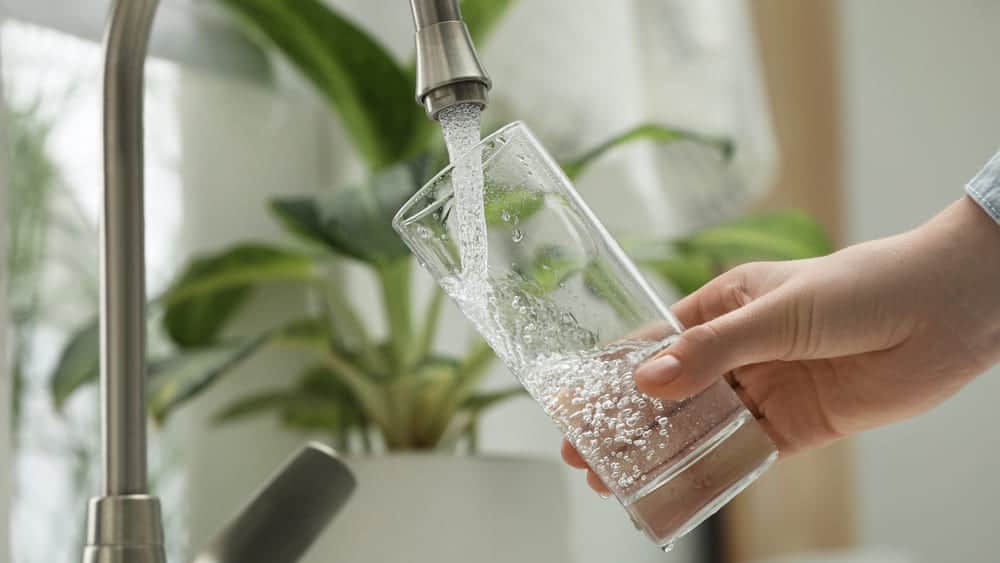
Municipalities are responsible for treating water before it is delivered to consumers as tap water. The treatment process often begins by temporarily holding raw water in settling ponds, with or without a coagulant such as ferric sulfate or aluminum sulfate, to allow suspended solids to drop to the bottom of the pond. Then the remaining water is filtered through media such as sand or synthetic membranes. The filtered water is disinfected using chemicals such as sodium hypochlorite (bleach), ammonia, chlorine, or some combination of these agents. Some municipalities also use ultraviolet disinfection.
Municipalities are generally vigilant in complying with federal and provincial guidelines for drinking water quality. Typically, they determine the quality of the treated water at frequent intervals through monitoring of the water’s turbidity (how clear or cloudy the water is) and its chlorine levels. They consider that if the water is clear and contains a disinfectant, it is safe from microbial infection.
Municipalities are very successful in removing certain amounts of solids, infectious agents, and organic matter from drinking water and are quite insistent that their drinking water is safe.
“Safe”, however, is a relative term. Multiple harmful substances can be found in Canadian drinking water, some of which were never envisioned when water treatment plants were designed.
Pharmaceuticals
When people ingest drugs, whether prescription drugs or otherwise, not all of the drug is metabolized, and the excess is excreted through urination and defecation into the wastewater. The same is true of antibiotics and other drugs commonly fed to livestock. The drugs that end up in the wastewater are commonly not filtered out at the wastewater treatment plants and remain in the drinking water.
It has been known for many years that pharmaceuticals are to be found in drinking water. In 2006, the Ontario Ministry of the Environment undertook a study of source waters and a number of drinking water systems over the course of 16 months. “Out of the 48 contaminant compounds analyzed, 27 were detected in source water, finished drinking water, or both.” The contaminants included drugs, hormones, and bisphenol A.
More recently, a study published in 2015 by the Society of Environment Toxicology and Chemistry investigated 17 “drugs of abuse” such as cocaine, amphetamines, opiates, and their metabolites and found that although there was “a decrease in concentration” of some of these drugs “with distance downstream from the wastewater discharge”, there was “little attenuation (decrease) of sucralose, cocaine, benzoylecgonine (a major metabolite of cocaine), morphine, acetylmorphine (a metabolite of heroin), acetylcodeine (a morphine derivative), and oxycodone” and concluded that “many of the drugs of abuse were not removed effectively in the DWTP (drinking water treatment plant)”.
That particular study limited its examination to drugs subject to abuse. Other researchers have also found 47 unique pharmaceuticals in Canadian drinking water. The detected drugs include ibuprofen, carbamazepine (an anticonvulsant), ethinylestradiol (an estrogen drug), various antibiotics, doxycycline (an antibiotic), naproxen (an anti-inflammatory drug), and many others.
Microplastics
The Government of Canada acknowledges that microplastics are “becoming ubiquitous in the environment”, noting that it has been found in surface water, groundwater, and drinking water as well as in various food sources. Their assertion that “exposure to microplastic pollution was not expected to be of concern for human health” is contradicted by multiple studies that detail the harmful health effects of microplastic ingestion (inflammation, oxidative stress, cytotoxicity, gut dysbiosis, infection, reproductive toxicity, developmental toxicity, cellular damage, etc).
Plastics contain multiple endocrine disruptive chemicals such as bisphenol A, phthalates, flame retardants, and many others as well as toxic metals. These toxins leach into the water.
Endocrine Disrupting Chemicals
Endocrine disrupting chemicals (EDCs) do just that – they disrupt and derange a person’s endocrine system. These are chemicals that mimic and block natural hormones and interfere with the body’s hormonal systems and functions.
Some well-known EDCs such as phthalates, parabens, bisphenols, pesticides, herbicides and others have been found in drinking water worldwide.
Another EDC, fluoride, is not merely found in the drinking water, it is usually added at the water treatment plants based on the belief that fluoride promotes dental health.
Metals
Metals including arsenic, lead, aluminum, cadmium, nickel, mercury, chromium, and zinc are to be found globally in drinking water. A 2018 study states that “the predominant course resulting in measurable human exposure to heavy metals is the consumption of contaminated drinking water.”
Ingestion of metals, particularly heavy metals, can pose a significant risk to health. Some of these heavy metals are also endocrine disruptors.
Is Bottled Water Safer?
Bottled water does not fare any better than tap water. In fact, a recent study found that bottled water contained more microplastic than tap water. Bottled water has also been found to contain arsenic, uranium, and various volatile organic compounds (VOCs) as well as pathogenic bacteria. One study notes that “Many observations and study reports have produced documented evidence that counts of coliforms (a type of bacteria) in these bottled waters exceeded national and international standards”.
How Much is Too Much?
Generally, federal and provincial guidelines for “maximum acceptable concentrations” of the various organic, non-organic, and chemical contaminants in drinking water are trace amounts. While these guidelines provide some measure of protection, what they overlook is the cumulative effect of exposure over time.
Some of the EDCs found in drinking water are classed as persistent organic pollutants meaning they stay in the body, specifically in the body’s fat cells. Researchers note that “as their structures are mainly lipophilic (having an affinity for fat), their ability to increase fat deposition (the development of fat tissue) has the added consequence of increasing the capacity for their own retention”. In other words, the bioaccumulation of persistent EDCs in fat cells generates more fat storage, which makes it extremely difficult to lose excess fat.
Even the non-persistent EDCs (those that the body is able to eliminate) can, through constant exposure, create functional gastrointestinal disorders, disruptions to the endocrine system, and other health concerns.
Heavy metals found in tap water is another source of health concern. The body has no natural means by which to remove heavy metals, so they accumulate in vital organs such as the heart, brain, lungs, kidneys, and liver. Heavy metals will also accumulate in the bones and lymph nodes.
The damage that an accumulation of heavy metals can do is extensive, not the least of which is intracellular dehydration.
Decontaminating Your Drinking Water
There are different methods by which tap water can be decontaminated, with varying degrees of effectiveness.
Boiling the Water
Some sources suggest boiling the water, but we don’t recommend that. Boiling water will kill off living organisms such as parasites, bacteria, and viruses, but it will not remove all neurotoxic chemicals commonly found in household tap water such as fluoride, pesticides, and industrial by-products. Boiling water will likewise not remove metals such as lead and copper, nor will it remove phthalate-leaching microplastics (and heating the water will actually speed up the rate at which the phthalates are released from the plastics into the water).
Ultraviolet Disinfection
UV disinfection uses germicidal ultraviolet light to kill many harmful organisms such as viruses and bacteria, although some parasites such as Cryptosporidium or Giardia are untouched because those organisms have thick cell walls that the UV light is not able to penetrate. UV light will likewise not have any effect on heavy metals, nor will it remove inorganic compounds such as various acids and sulfur, or particles such as microplastics from the water.
Filtration
Another method of water decontamination is filtration. Filtration is the process of moving water through a filter to capture particles suspended in the water on the surface of or in the pores of the filter.
The size of the filter’s pores determines the degree to which organisms and chemicals are captured and removed. The smaller the filter’s pores, the more it will capture and remove from the water.
Microfilters have a pore size of approximately 0.1 micron and will remove some bacteria and viruses but few to no chemicals.
Ultrafilters have a pore size of approximately 0.01 micron and will remove bacteria and some viruses but few chemicals.
Nanofilters have a pore size of approximately 0.001 micron and will remove bacteria and viruses and some chemicals.
Distillation
Distillation is the process of boiling water until it evaporates. The evaporate (the steam) is then captured and condensed into a separate clean container. Anything in the water that has a boiling point higher than water won’t evaporate and is left behind.
The distillation process will kill most bacteria, viruses, parasites, and fungus and will remove many organic metals and soluble minerals. Distillation does not, however, remove all of the chemicals. VOCs such as various ethylene compounds commonly found in tap water, for instance, have a boiling point close to or lower than water so they will vaporize and be present in the distilled water unless they are specifically filtered out.
Reverse Osmosis
Reverse osmosis systems are very effective in decontaminating water. In reverse osmosis, the water is forced through a semi-permeable membrane. Many reverse osmosis systems have very fine (0.0001 micron) pre and post filters that work with the membrane to effectively remove almost all bacteria and viruses, amoeba, and common contaminants including endocrine disrupting chemicals and heavy metals.
As one study notes, “Reverse osmosis membranes retain 95-99% of the dissolved solutes (organic and inorganic) from the feed stream into the concentrate, while the permeate can be considered as high-quality water.” In other words, reverse osmosis removes 95-99% of the impurities.
What is the Best Way to Decontaminate Drinking Water?
Of the various decontamination methods listed here, reverse osmosis filtration is hands-down the best. Essential minerals are either retained or can be added back in during the reverse osmosis process.
Distilled water would be our second choice. Distilled water lacks electrolytes such as potassium, calcium, magnesium, and other minerals. The lack of electrolytes in distilled water has led to a controversial hypothesis that drinking it will alter electrolyte and mineral metabolism in the body.
Our third choice is water treated by a good carbon filtration system. There are numerous such systems, and all of them claim to be the best on the market. What we recommend is that if you opt for carbon filtration, compare the different systems for what they will and will not remove, and what their certifications are.
Different Types of Home Water Decontamination Devices
Broadly, there are two different types of devices, point of use (POU) and point of entry (POE).
POU devices include, countertop filters, shower head filters, faucet-mounted and faucet-integrated filters, under-sink filter systems, and other location-specific systems.
The advantage of POU devices is that they are relatively inexpensive and often do not require professional installation. The disadvantage of POU devices is that the decontaminated water is available only in specific taps in the house, usually the kitchen, which could expose you to dermal absorption of EDCs in other areas of the house such as the bathrooms.
A POE device is installed where the water line enters the house. The advantage of a POE system is that it brings decontaminated water to every tap in the home. The disadvantage is that they can be expensive and often require professional installation.
The Importance of Decontaminating Your Water
Whether you prefer a POE or a POU system, the important point is to have decontaminated water for drinking and cooking.
Water performs many important functions in the body. Among other things, water:
- helps regulate body temperature
- lubricates and cushions the joints
- moistens the eyes, nose, and mouth
- helps to protect tissue
- removes waste from the body through urination, defecation, and perspiration
- aids in digestion
- hydrates the skin
- carries nutrients and oxygen to the cells
The body simply cannot function without water. Drinking a sufficient amount of water each day is an absolute necessity for good health.
Be sure that the water you’re drinking and cooking with is high quality, decontaminated water.
Green Apple Health Care practices Cause Based Medicine® which is the systematic process of finding and treating the core cause of health concerns by using a classic naturopathic approach combined with scientific research to optimize patient outcomes.
Our focus is cause-based. We are relentless in identifying the root cause, the “why” behind the symptoms, and we address our treatment programs to the cause of the health condition, not the symptoms.
Call us at (780) 485-9468 to book a consultation. If you prefer, online booking is available for both new patients and repeat patients.